
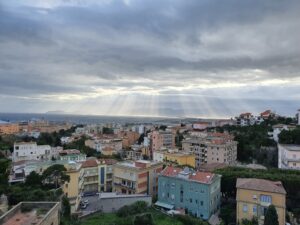

If you’re thinking about visiting Cagliari in November, you’re probably trying to figure out one thing first: will you still find a lively city outside the summer season, or will everything be closed?
Here’s the short answer: Cagliari doesn’t shut down when summer ends. Unlike some of Sardinia’s more seasonal beach destinations, the city doesn’t live on summer tourism alone. Restaurants, bars, shops, museums, public transport and most of everyday city life continue throughout the year, although things are quieter and opening hours can change depending on the place or service.
What does change is the kind of trip you can expect. November definitely isn’t a month I’d rely on for a beach holiday. The weather is more unpredictable, the days are much shorter and some summer-only services are reduced or simply unavailable. And despite what you may sometimes hear about Sardinia being sunny all year round, it can absolutely feel cold here too :-D.
If, on the other hand, you want to explore Cagliari, walk around its historic neighbourhoods, visit museums and archaeological sites, eat well and maybe spend a few hours at Poetto Beach when the weather cooperates, November can make a lot of sense. It might even suit you better than summer if, like me, you’re not a big fan of heat and crowds.
What is Cagliari really like in November?
One of the easiest mistakes to make when planning an off-season trip to Sardinia is assuming that the whole island slows down in the same way. A place that depends heavily on beach tourism can change dramatically once summer is over. Cagliari is different, because most of what keeps the city running has very little to do with tourists.
That doesn’t mean November feels anything like July. There are far fewer visitors, some seasonal businesses disappear and the most touristy areas are noticeably quieter. But Cagliari mostly goes back to its everyday rhythm.
It’s also worth remembering that this isn’t a small seaside resort. Cagliari itself has more than 145,000 residents, and the population rises to around half a million if you include the wider metropolitan area. In practice, the Metropolitan City of Cagliari accounts for roughly a third of Sardinia’s population.
That’s one of the reasons everyday life here doesn’t depend on the tourist season in the same way it does in a purely beach-oriented destination. Most bars and restaurants continue to work in November, including several places close to the coast, although you’ll obviously find a much more local crowd. There are also events and activities throughout the month, including a few that only take place at this time of year.
What stays open in Cagliari in November?
For normal city life, less changes than you might expect. Restaurants, cafés, shops, supermarkets, markets, public transport and the main cultural attractions continue to operate.
What you do need to pay more attention to are winter opening hours and activities that depend directly on the summer season. At the moment, for example, the National Archaeological Museum is open every day from 8:30 am to 7:30 pm, while the Botanical Garden switches to 9:00 am–2:00 pm, Tuesday to Sunday, between November and March. If there’s somewhere specific you want to visit, always check the latest opening hours before you go.
What actually changes after summer?
The biggest differences are connected to the beach season. Some beach services and establishments close, excursion options and tourism-only activities become more limited, and the extra summer public transport services are no longer all available or don’t run as frequently — including some of the additional connections between the city centre and Poetto.
In the centre, though, the main difference is simply that there are far fewer visitors. And depending on the kind of traveller you are, that might actually be an advantage: you can take things more slowly without the summer crowds.
Basically, Cagliari becomes a more normal version of itself, with plenty still going on but fewer services aimed specifically at people coming here for the beach.
Practical updates to check before your trip
Some practical details in Cagliari can change from year to year, so it’s worth checking them shortly before your trip. These are two of the most important ones right now.
San Benedetto Market is not in its historic building at the moment.
If a guide sends you to the old Mercato di San Benedetto building in Via Cocco Ortu, the information is out of date. The historic market is currently closed for renovation work, and the traders have moved to the temporary structure in Piazza Nazzari, which hosts around 170 operators. The market is fully active, but you won’t find the building that still appears in many older articles and photos online. Current opening hours are 7:00 am–2:00 pm Monday to Friday and 7:00 am–3:00 pm on Saturday.
There may still be works and temporary traffic changes around Via Roma and the port.
The new Via Roma promenade is already open, but that doesn’t mean the whole area between the city centre and the port is free of works. In 2026, gas network works and projects connected to the light rail system caused restrictions and slowdowns around Via Roma, Piazza Deffenu and the port area. If you’re mostly exploring on foot, the impact may be limited. If you’re arriving by car or crossing this area often, it’s worth checking the latest situation before your trip.
These practical details can change, so always double-check shortly before travelling.
Cagliari weather in November: what to expect
November in Cagliari is generally mild, but the first and second halves of the month can feel quite different. My own experience obviously isn’t enough to turn that into a rule, so it’s more useful to look at long-term climate averages: typical daytime highs drop from around 21°C (70°F) at the beginning of the month to around 17°C (63°F) towards the end. Typical lows fall from roughly 13°C (55°F) to around 9°C (48°F).
Of course, these are climate averages, not a forecast for your specific trip.
And temperature alone doesn’t tell you everything. With sunshine and little wind, 18 or 19°C can feel very pleasant. With cloud, humidity or a strong Maestrale blowing, exactly the same temperature can feel much cooler, especially close to the sea or after sunset.
My advice is simple: dress in layers and bring something that protects you from both wind and rain. You usually won’t need a proper heavy winter coat, but I wouldn’t travel with summer clothes alone either.
How much does it rain?
November is considered one of the wetter months of the year in Cagliari. Different historical climate datasets don’t completely agree on the average amount of rainfall, so a single monthly figure is less useful than it might seem.
The important thing to know is that you shouldn’t plan your entire trip assuming you’ll have sunshine every day.
That doesn’t necessarily mean you’ll get whole days of rain. It simply makes sense to have a few indoor alternatives in your itinerary and check the forecast as your trip gets closer. If significant bad weather is expected, I’d also check the official Civil Protection alerts rather than relying only on a standard weather app. You can find the regional alerts on this website.
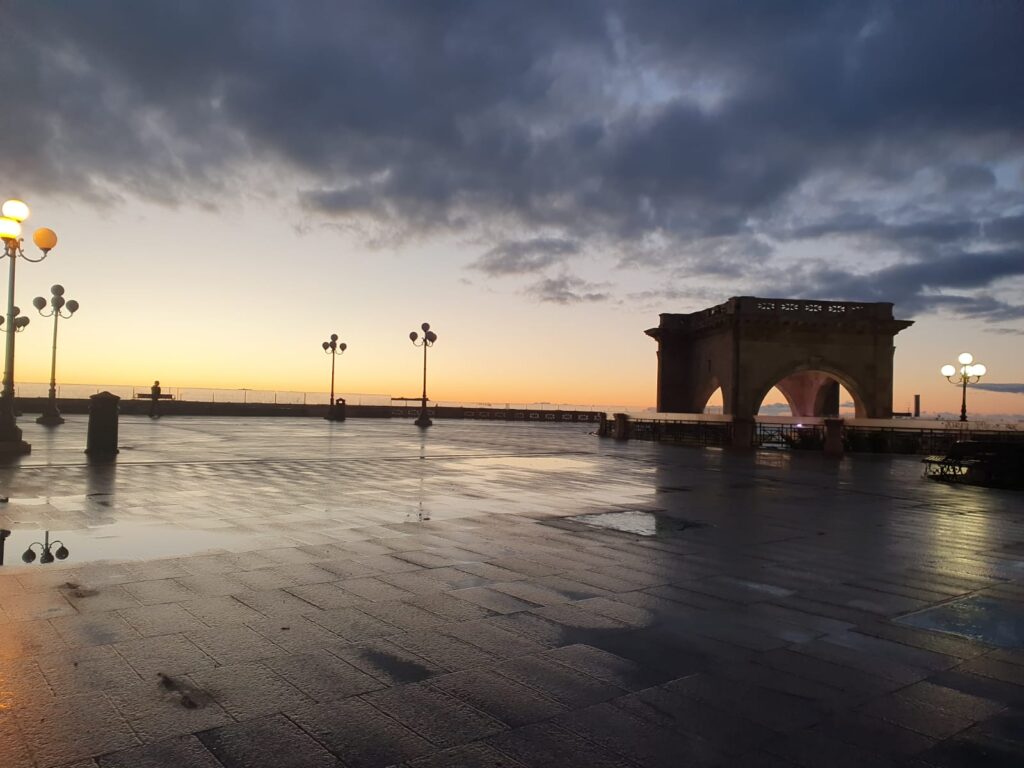
Wind can completely change how the day feels
In Cagliari, it’s worth checking the wind as well as temperature and rain. You’ll notice the difference most in open and exposed areas such as Poetto, the higher parts of Castello, the viewpoint above Monte Urpinu or the hill around Castello di San Michele. A pleasant sunny day in the city centre can feel much cooler once you move somewhere more exposed.
Wind direction matters too. With the Maestrale, which comes from the north-west, the sea at Poetto can be relatively more sheltered, but strong gusts can make the air feel much colder. The Scirocco, from the south-east, hits this part of the coast more directly and can make the sea rougher.
You obviously don’t need to become an expert in Sardinian winds. But if you’re planning to spend several hours at Poetto or Molentargius, checking both wind speed and direction before you head out can be genuinely useful.
Watch the sunset: after 5 pm, the day changes
If you’re used to visiting Sardinia in spring or summer, this is probably one of the biggest differences. In November, sunset is at around 5:22 pm on the first day of the month, around 5:10 pm in mid-November and close to 5:00 pm by November 30.
That means it makes sense to use the morning and early afternoon for outdoor activities, viewpoints and longer walks, when you can also take advantage of the warmer part of the day.
After 5 pm you can move towards the historic centre, visit museums that stay open later, or head to a bar or restaurant. You don’t need to plan every hour of your day, but keep in mind that your daylight window is much shorter than it is in summer.
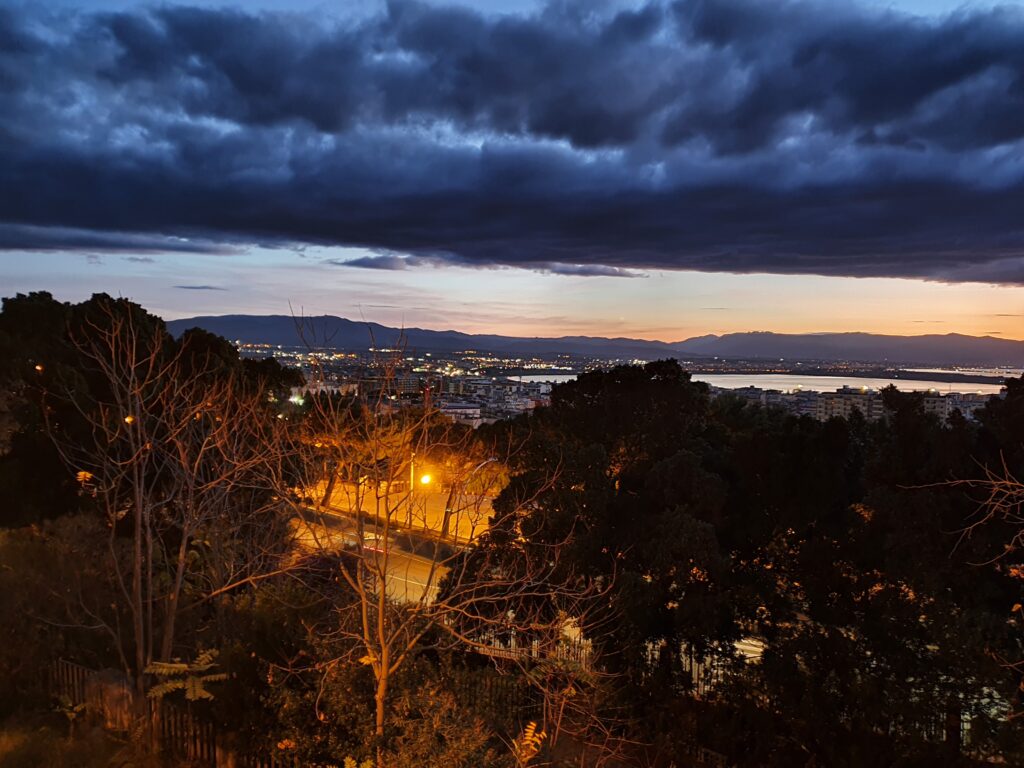
Is Poetto Beach worth visiting in November?
Because Poetto comes up so often when people ask about Cagliari, it’s worth answering this separately: yes, I still think it’s worth going — just not for the same reasons you’d go in summer.
In November, Poetto loses much of its summer beach-resort feel and becomes much more of an everyday part of the city. People come here to walk, run, cycle or just stroll along a much emptier shoreline. On windy days, it’s also not unusual to see people kitesurfing and windsurfing.
Another thing worth clearing up: it isn’t true that every bar and restaurant in the area closes in autumn and winter. Some permanent businesses continue to operate outside the summer season. Il Lido, for example, explicitly says it stays open all year and even offers winter-season options. Emerson keeps its bar and restaurant open daily, while Corto Maltese also hosts concerts and evening events outside the summer months. Opening days and hours can obviously change, and beach-specific services aren’t the same as they are in summer.
One more thing to keep in mind on rough-weather days: during strong storms and sea swells, especially with winds blowing from the south-east, the sea can push much farther up the beach than you might expect. At Poetto, this can temporarily leave only a narrow strip of dry sand — and during the roughest conditions, some sections of the beach can almost disappear under the water. This isn’t the normal November situation, but if the forecast shows strong wind and rough seas, don’t assume Poetto will look anything like it does on a calm sunny day.
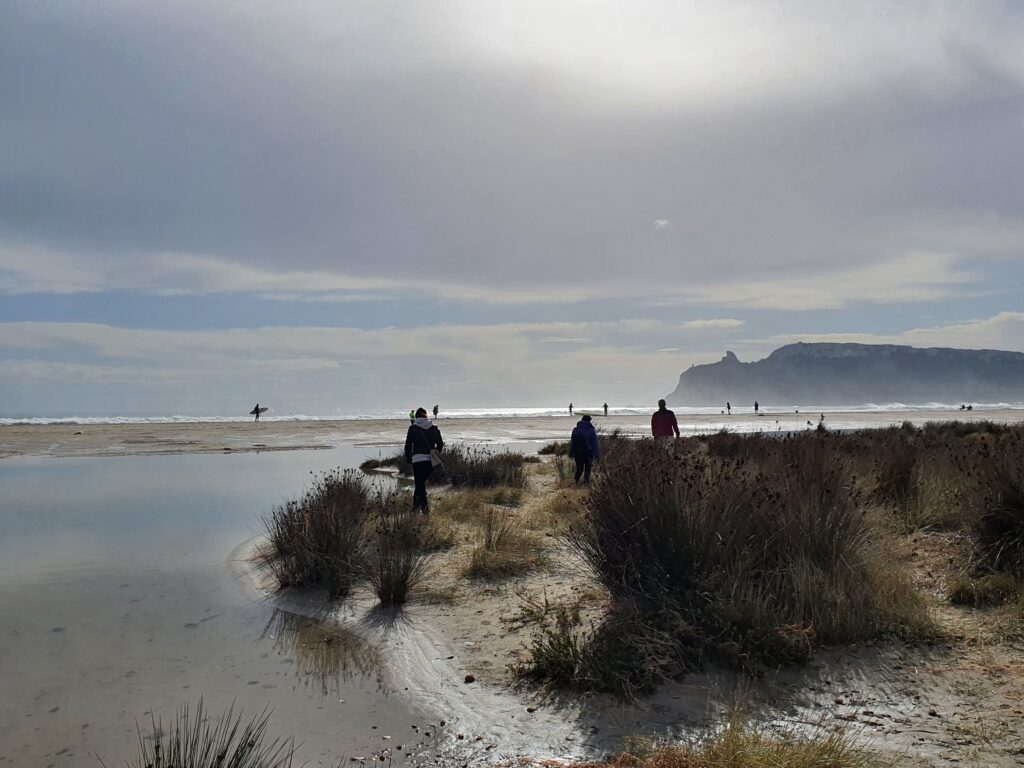
Can you swim in Cagliari in November?
Yes. I’ve actually done it myself more than once since moving to Cagliari. But it depends a lot on the day and on how comfortable you are with cooler water.
Average sea temperatures in November are roughly 19–20°C (66–68°F). There’s also a noticeable difference during the month: historical averages are around 21°C (70°F) in the first few days and fall towards 18°C (64°F) by the end.
So swimming on a calm, sunny day is definitely possible, and some people continue to swim outside the summer season. But the most useful and cautious answer if you’re planning a trip is this: don’t choose November expecting to spend every day on the beach and swim whenever you want.
If conditions are right, think of it as a bonus. Bring your swimsuit just in case — it hardly takes up any room anyway ;).
What is actually worth doing in Cagliari in November?
As I mentioned earlier, there’s no need to invent a special list of “November activities”. Castello, the museums, the Bastione and the vast majority of attractions in Cagliari aren’t seasonal.
If anything, there are a few things that can work particularly well at this time of year.
Walk around the historic neighbourhoods without the summer heat
Castello, Stampace and Villanova have plenty of hills, staircases and streets exposed to the sun. On a mild November day, walking around for several hours can be much more pleasant than doing the same thing during the hottest and most humid months.
Of course, that advantage disappears pretty quickly if you get unlucky with rain or strong wind. That’s probably one of the reasons November works best if you plan day by day. Still, in my opinion it’s easier to solve the problem by putting on an extra layer than it is to escape the heat in summer. If you struggle with hot weather as much as I do, walking around Cagliari in July or August can honestly become pretty unpleasant.
Visit Molentargius on a good-weather day
Molentargius Park isn’t just a summer place: flamingos are present throughout the year, and you can also reach the area by public transport. It’s a genuinely lovely place for a relaxed walk, especially when you don’t have to deal with the high temperatures of a few months earlier.
One extra tip: if Poetto is already in your plans, Molentargius is easy to combine with it because the two areas are very close. On a clear day, it’s one of the best ways to make use of the middle part of the day without really leaving the city.
Museums — especially when the weather turns
If the weather changes, a museum that stays open into the evening becomes much more useful in November than it would be on a perfect summer day. The National Archaeological Museum is the easiest example: you can leave it until later, when there isn’t much daylight left outside anyway.
What’s on in Cagliari in November 2026
November isn’t a month with nothing going on. Several events are already confirmed across the city throughout November 2026.
3, 17 and 24 November — Storie di volti e silenzi, Pirri
The tenth edition of this silent-film series continues at Spazio Hermaea in Pirri, a district of Cagliari, with screenings and talks based around the theme Alle origini del mistero: detective, criminalità e psiche. The November events are scheduled for 8:00 pm and admission is free.
5–10 November — Cagliari FestivalScienza
The nineteenth edition, titled Visioni, includes talks, meetings with scientists, workshops, exhibitions, presentations and other science-related events.
11–15 November — Uno Sguardo Nuovo – Sardinia Queer Film Expo
A film festival dedicated to LGBTQIA+ short films and other works. Events take place in Cagliari as well as other locations around Sardinia, so check the programme to see exactly what’s happening in the city.
19–22 November — Pazza Idea Festival
The fifteenth edition, Geografie Umane, takes place at Teatro Carmen Melis and covers literature, art, photography, digital culture, music, readings, panels and talks.
30 November — Cagliari vs AC Milan, Serie A
If you’re into football, this is one of the most interesting home fixtures of the period. Cagliari–Milan is currently scheduled for Monday 30 November at 8:45 pm. For a match like this, it’s worth checking ticket availability and sales through the official Cagliari Calcio channels well in advance.
Event information is updated for 2026. Dates, times and programmes can change, so always check the official websites before organising your day around an event.
Getting around Cagliari in November: do you need a car?
If your trip is focused entirely on Cagliari, no. Marina, Stampace, Castello and Villanova are best explored on foot. For places farther away, you can use the CTM public transport network, which runs throughout the year.
Public transport to Poetto is boosted during summer with extra services and routes, but the normal urban network continues to serve the beach outside the summer season too.
Getting from the airport to the city centre is also very easy. The train between Cagliari Elmas Airport and Cagliari station takes less than 10 minutes; the current fare is €1.30 and Trenitalia says trains run on average about every 20 minutes on weekdays.
A car becomes much more useful if you want to use Cagliari as a base for exploring other parts of southern Sardinia, especially places where public transport takes longer or requires awkward connections.
I’ve already written two more detailed guides on this:
Do You Need a Car in Sardinia? Probably (But Not Every Day)
How to Use Buses in Cagliari: Tickets, Payment, and Getting Around
So, is November a good time to visit Cagliari?
Absolutely, yes. In fact, it might suit you even better than the hottest and busiest part of the year — as long as the beach isn’t your main priority.
If you want a city break with historic neighbourhoods, archaeology, museums, food, long walks and the chance to spend some time by the sea when the weather cooperates, November can work really well.
You do need to accept three compromises: less predictable weather, limited daylight in the late afternoon and a much smaller beach-oriented offering than in summer. So if the trip you have in mind revolves around beaches, daily swims, boat trips and long summer days, I’d choose another time of year.

[…] Sardinia’s capital during the last month of the year. As I mentioned in an earlier article, Cagliari in November is still a lively city, with plenty going on and several events that might be worth checking out. But not everyone knows […]